 ATPenn
Why most club ladders fade
A club ladder usually starts well. Someone draws up the table, pins it to the noticeboard or shares a spreadsheet, and the first few weeks are busy. Then it slows down. Results arrive late or not at all. The players at the top stop accepting challenges, because they have more to lose than to gain. The players in the bottom half work out that they will never get near the top and stop looking. A few months in, the table describes a club that no longer exists.
The usual cause is the design of the ladder. A ranking that people follow has to be quick to update, fair in a way players can see for themselves, and worth looking at for more than the top three. Here is how to build one.
Decide what the ranking is for
Before you pick a format, be clear about the job. A club ranking can give players a reason to play more often, help you put similar players on the same court, and give you a sensible order for tournament draws. It isn't a verdict on who matters at the club, and it's worth saying so when you launch it. Players who see the ranking as a way to get good games take their losses much better than players who treat it as a status board.
Pick a format, and know where it breaks
There are three common ways to rank a club, and each one fails in a predictable way.
Players challenge someone a few places above them. If the challenger wins, they swap places. Simple, and good for drama.
Where it breaks: avoidance. Players near the top can delay or dodge, and the ladder freezes. If you use one, set a deadline for accepting a challenge and decide in advance what happens when it's missed.
Every match earns points: a set number for a win, fewer for a loss. Easy to explain on day one.
Where it breaks: volume. Whoever plays the most climbs, even if most of their matches are against weaker players.
The points depend on who you played. Beating a stronger opponent earns more, beating a weaker one earns less, and losing to a stronger opponent costs little.
Where it breaks: it can feel like a black box. Players need to see the numbers before and after a match, or they stop trusting it.
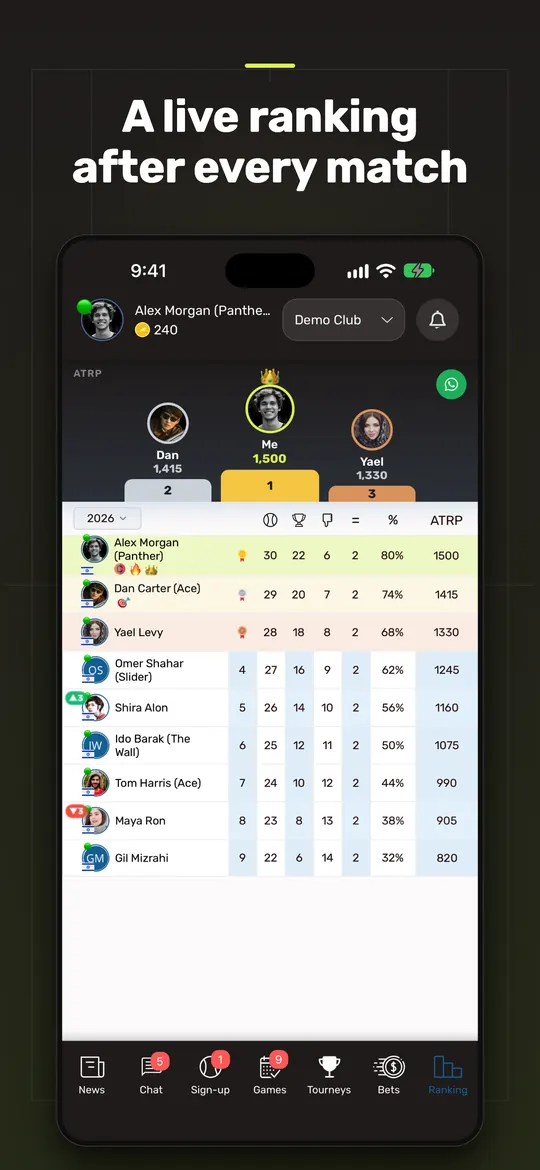
For most social clubs, a rating-based ranking works best, as long as players can see how it works.
Make fairness visible
Players accept a ranking they understand. A few principles go a long way:
- A win against a stronger opponent is worth more than a win against a weaker one.
- A close loss to a stronger player shouldn't cost much.
- The margin can count, but not so much that people start running up the score against friends.
- In doubles, judge the pair against the pair. Winning alongside a much stronger partner says less about you than winning with an equal one.
- Games at a higher level can count a little more, which gives players a reason to move up.
Most important of all: show what's at stake before the match. If both sides know what a win, a draw or a loss is worth, nobody argues about it afterwards.
Get results in the same day
A ranking is only as good as its results, and two rules keep them coming in. First, the players enter the score themselves, straight after the match, instead of reporting it to an organiser who types it in on Sunday. Second, one person, the club manager, can correct a mistake. A typo then never turns into a dispute, and nobody can tidy up their own record. If a score still isn't in a while after the match, a reminder should go out without anyone having to send it.
Results also depend on matches being played. A weekly schedule with one sign-up list per game feeds a ranking far better than challenges players have to arrange themselves.
Run it in seasons
A table that never resets becomes out of reach for anyone who joins late. Seasons fix that. A calendar year is a natural length for most clubs: long enough for the table to mean something, short enough that a newcomer gets a real chance next time round. Keep past seasons visible. Players like to look back at where they finished.
Give the middle of the table something to chase
Only a handful of players can realistically win the season. Everyone else needs goals they can reach this month. Some that work well:
- Monthly awards for the most wins, the best win rate and the biggest climb in the table. The biggest-climb award is the one that keeps the middle and the bottom of the table paying attention.
- Personal records: win rate, longest winning streak, current form.
- Head-to-head records. Being 0–3 against one particular rival motivates people more than any position in the table.
- Moving up a level, from B games to A/B games to A games.
Use tournaments as checkpoints
A ranking runs all season; a tournament fills a weekend. They work well together. If you seed the draw, the ranking gives you an order nobody can argue with. Formats that suit clubs: a knockout for a quick event, groups followed by semi-finals and a final for a full day, and a league where everyone plays everyone for a small group over a few weeks. For social doubles events, drawing pairs so that each stronger player partners a developing one makes for closer matches.
Mistakes to avoid
- Updating the table once a month. By then nobody remembers the matches, and nobody checks.
- Hiding the formula. If players can't see why they moved, they assume it's unfair.
- Letting anyone edit results.
- Challenge rules that nobody enforces.