 ATPenn
What efficiency means on club night
When organisers talk about padel club efficiency, they rarely mean squeezing in more games. They mean that every court the club pays for has four players on it, at a similar level, and all four turn up. An empty place costs the same as a full one. A badly matched four costs more over time, because the players who had a poor evening book less often.
Take a Tuesday night with four courts from 7pm to 8:30pm. That's sixteen places. The evening works when sixteen players at roughly the right levels are signed up by Monday night and are all still coming at six on Tuesday. Everything below is about reaching that point with less work. It applies to tennis doubles in the same way, and a singles court only needs two.
1Fix the slots and open them at the same moment
Tuesday should look the same every week: the same four courts, the same start time, the same level on each court. Say court 1 is A, courts 2 and 3 are A/B and court 4 is B. Players learn the pattern and plan their week around it, and you stop building the evening from scratch every Sunday.
Open next week's games for sign-up at one fixed time, Saturday morning for example. Everyone knows when to look, so first come, first served is fair, and most of Tuesday's names are in by the weekend while there's still time to fix the gaps. The guide to running a weekly schedule covers the template in more detail.
Be honest about slots that never fill. If court 4 is half empty most weeks, move that game to a night people actually want, or, if you rent the court, stop booking it. A court you don't need is the easiest saving there is.
2Set a sign-up deadline
Without a deadline, sign-ups drift into Tuesday afternoon, and so do the gaps. Pick a cut-off the day before, say Monday at 8pm, and treat it as the moment the evening is set. After it, a player who drops out finds a replacement or pays their share of the court. Clubs vary on the details. The rule matters less than writing it down before anyone needs it.
The deadline also gives you one moment to look at the whole evening. At 8pm on Monday you can see that court 2 has three and court 4 has two, and you still have a day to move people around. Without it you find out at half past six on Tuesday, when nobody is free.
3Keep a waitlist for the slots that fill first
Some slots fill within the hour, others struggle all week. For the popular ones, keep a waitlist in the order people asked, and move the first name up as soon as a place opens. Tell people where they stand. A player who knows they're second in line keeps the evening free, while a player who heard nothing makes other plans.
A waitlist is also information, and it's where a lot of padel club efficiency is quietly lost. If the A court has a waitlist every week while court 4 has empty places, you don't have too few players. You have the wrong mix of levels on the night. Change one court's level before you book another court.
4Balance levels before you balance numbers
At five on a Tuesday the temptation is to put anyone into the empty place. Do it once and you've saved a court. Do it every week and the three regulars on that court start playing somewhere else. A court with a mismatched four is full, but it isn't working.
Set each player's level yourself after watching them play, rather than asking them, and put a level on every slot. The A/B courts give you room to move: a strong B player can fill a gap there without anyone being out of their depth. Within the four, pair the strongest player with the weakest. The guide to padel courts, pairs and levels covers sides, pairs and when to move someone up.
5Fill gaps by asking people, not the group
"Anyone for Tuesday?" posted to a big group gets silence, because everyone assumes someone else will answer. A direct message to two players who are the right level and aren't already playing that night usually gets a reply. Ask the three who are already in the game, too. They know who's free.
- Check open places at the deadline and again on the morning of the game.
- Offer the place at the right level first, and only widen it once the players who fit have said no.
- If a B game is still on three by lunchtime, open it as A/B. A slightly stronger fourth is better than a cancelled court.
- Keep a short list of people who are happy to be called late, and thank them every time they help.
6Reminders, and what to do about no-shows
Most no-shows aren't rudeness. People forget, or believe they cancelled when they only meant to. Reminders handle most of it: a summary of who's playing where on the morning of the game, a nudge shortly before the start, and a request for the score afterwards. They should go out on their own. An organiser who sends them by hand every week will eventually stop.
For the no-shows that remain, keep one rule and apply it to everyone. A player who doesn't turn up and didn't warn anyone pays their share of the court. If it keeps happening, they lose their priority on the popular slots for a few weeks. Talk to the person before you apply it the first time. Sometimes there's a real reason, and often the conversation is enough on its own.
Post the rules where people will see them, not halfway up a busy chat, and repeat them at the start of each season.
When this is more than you need
If your club is one court on one night with the same four friends, skip all of it. Padel club efficiency starts to matter once you have more players than you can keep track of in your head. Below that, a group chat and a bit of goodwill fill the court just fine, and a deadline would only annoy people.
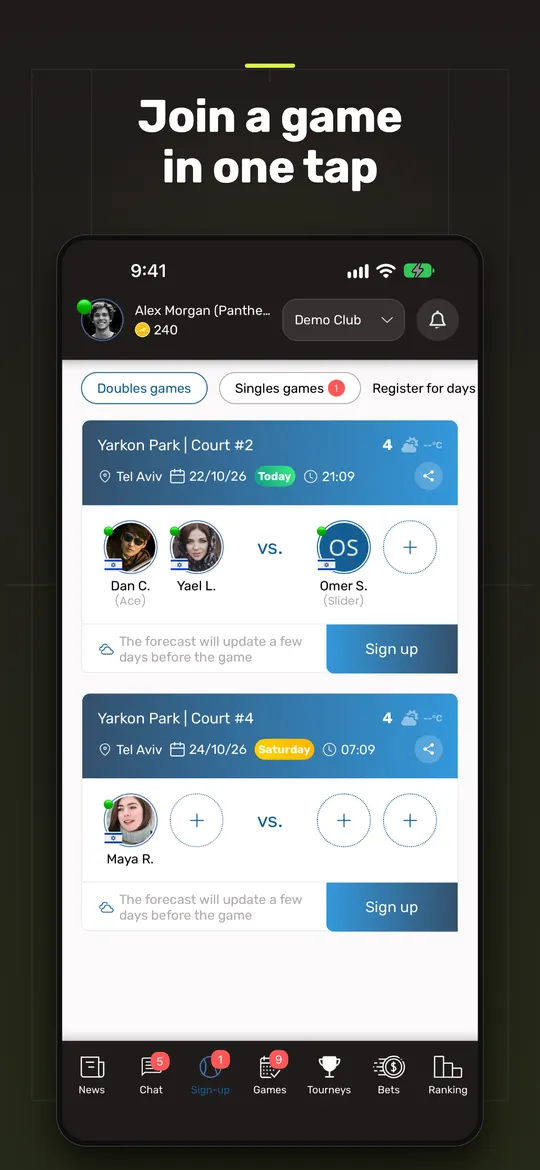
When you do grow past that point, the same routine works on paper, in a spreadsheet or in an app. How ATPenn handles the weekly side is described below and on the page for clubs, and you can get the app to try it with your own players.