 ATPenn
When a box league is the right choice
A box league suits a club where members range from beginners to strong players and nobody enjoys a 6-0 6-0 evening. Every player ends up in a small group of people at roughly their own level. Everyone plays every other person in the box. Each season sorts the groups again, so the games stay close.
It fits singles tennis best. It also works for pickleball singles, and for padel and doubles pickleball if you use the four-player box described below. Skip it if you have fewer than about twelve regular players, because you cannot build three sensible boxes. Skip it too if your members want a social evening with a different partner every week. A fixed-night rotation suits that better, and the weekly schedule guide covers it.
Think of the box league as the middle option between a free-for-all and a ladder. A ladder lets anyone challenge anyone and drifts. A box league gives every player a fixed list of opponents and a fixed end date.
How many players in a box
Choose five if you can. Here is why.
- Four players: three matches each. Quick, but a season is over in three rounds, and one no-show wrecks a third of someone's results.
- Five players: four matches each, five rounds, one player resting each round. This is the best balance of enough games and a season short enough that people stay interested.
- Six players: five matches each, five rounds with three matches in each. It works, but it asks more of everyone's diary and a missing player hurts more.
Seven or eight players in one box is too many. Players lose track, matches slip, and the last games are played weeks after the first.
Your player count rarely divides neatly. Say you have 23 players. Make three boxes of five and two of four, which is 15 plus 8. Put the four-player boxes wherever the gaps in level are easiest to fill. If one player is left over, add them to the lowest box and make it a six, or hold them as a reserve to cover a dropout.
Who plays whom
Inside a box it is a round robin: every player meets every other player once. In a box of five that means ten matches. The table below gives a fixed order for five players, numbered 1 to 5 by seed (or by the order you draw them).
| Round | Match | Match | Rests |
|---|---|---|---|
| 1 | 1 v 5 | 2 v 4 | 3 |
| 2 | 2 v 5 | 3 v 4 | 1 |
| 3 | 3 v 5 | 1 v 2 | 4 |
| 4 | 4 v 5 | 1 v 3 | 2 |
| 5 | 1 v 4 | 2 v 3 | 5 |
Each player appears once in every round or rests, each rests exactly once, and each of the ten pairings turns up once. Hand the table to the box with real names in place of the numbers and the argument about who is playing next never starts.
For a box of four the three rounds are 1 v 2 and 3 v 4, then 1 v 3 and 2 v 4, then 1 v 4 and 2 v 3. Nobody rests, and two courts handle each round.
A box of six needs five rounds with three matches each. Write that grid out once for the whole season rather than letting players pick their own order.
Seeding the first season
You have no results yet, so ask each member for an honest self-rating and sort the list yourself. Put anyone you are unsure about one box lower. Moving up after one season feels good. Being crushed in the top box in week one makes people quit.
A deadline for every round
Without deadlines, a box league becomes a pile of "I'll text you next week". Choose one of two models.
- Weekly rounds with a fixed cut-off. Round 1 must be played by the first Sunday, round 2 by the second, and so on. Pick this for boxes of four or five. It keeps the whole box moving at the same pace.
- One window for the whole box. Players arrange their own order, but all matches finish by one date. Pick this only for a keen, well organised club. The risk is that four players finish early and the fifth does everything in the last weekend.
Whichever you choose, add a catch-up week at the end. A five-player box then runs for six weeks: five rounds plus a spare. A box of four runs for four. The spare week absorbs holidays, rain and injuries without moving the finish date.
Put the duty to arrange the match on the player named first in each pairing, and tell them so: they contact the other player and offer at least two slots. If the opponent refuses both, the opponent is the one who has not made the effort. That small rule settles most disputes before they begin. If a box is still behind by round 3, a short nudge from you to the whole box does more than chasing individuals.
Match length
Set a format that fits the time people can find. For tennis, two sets with a 10-point tie-break instead of a third set is a sensible default, and one court for about 90 minutes usually covers it. For pickleball singles, a single game to 11 or a best of three keeps matches short. A padel match normally fits a standard 90-minute booking. Whatever you pick, write it into the rules so players do not negotiate it each time.
Scoring, promotion and relegation
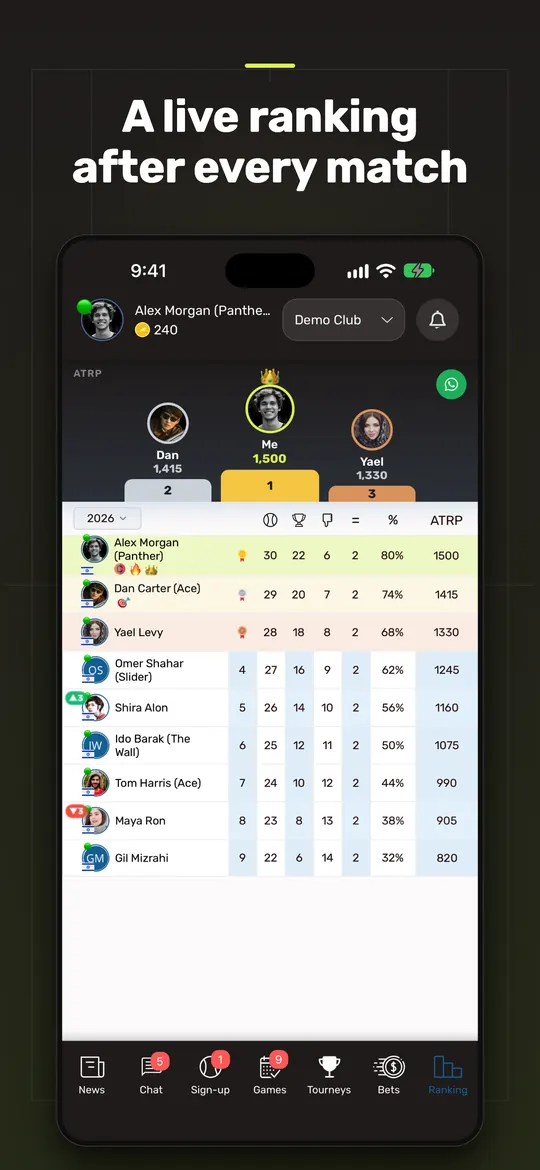
Keep the points simple: a win is worth more than a loss, and a played loss is worth something so players do not avoid weaker opponents. Three for a win and one for a played loss is a common choice. Rank by points first. If two players are level, use the result between them. If three are level, use game or set difference across the whole box. Write that order down before the season starts.
At the end of the season the top of each box moves up and the bottom moves down. A common setup for boxes of five is two up, two down. It balances: a middle box loses two upwards and two downwards, gains two from the box above and two from below, and so stays at five. The top box only sends players down and receives two from below, and the bottom box only sends players up, so those balance too.
For boxes of four, move one up and one down. For six, move two up and two down. If you worry about too much reshuffling, move one up and one down in every box size, though sorting then takes longer. For a first season with boxes of five, choose two and two: a strong newcomer finds their level in a season or two.
Players who drop out between seasons
Before the next draw, ask every member whether they are in. Do the moves first, then fill the gaps. A newcomer or reserve always starts in the lowest box, never mid-table, and the places they leave open higher up are filled by the players moving up from below.
What to do with unplayed matches
Some matches will not be played. Decide the rule before the season, publish it, and apply it the same way every time.
- Both sides tried and the dates would not work. The match is void: no points to either player. It is nobody's fault, and this keeps the table honest.
- One player offered dates and the other did not respond or turn up. Award the match to the player who made the effort, as a walkover with a nominal score. Say clearly that it counts as a win for them and a loss for the other player.
- A player is injured or leaves part-way. If they have played fewer than half their matches, remove their results entirely, so nobody gains or loses from games that no longer exist. If they have played half or more, played results stand and the rest are void.
The test for any rule is this: does a player who tried lose out? If yes, change it.
Avoid chasing late scores. Set a hard cut-off: any match without a score by the end of the spare week is treated as unplayed. Ask winners to send the score the same day, because a week later nobody remembers it. After the cut-off, only you change a result.
Do not change the rules halfway because someone complains. If a rule produced a bad result, note it and fix it for the next season. Players accept a rule they disagree with if it was published first and applied the same to everyone.
Doubles boxes for padel and pickleball
Padel and doubles pickleball can run on boxes of four players: one court, three rounds, and the partners change each round. With players A, B, C, D:
- Round 1: A and B v C and D.
- Round 2: A and C v B and D.
- Round 3: A and D v B and C.
Each player partners every other player once and plays against each of them twice. Score each person individually, using games won across the three rounds, or wins first and then games. The player with the best total finishes first.
The deadline logic is the same as before, but the whole box has to find one slot together, so fix three dates in advance and ask the four to keep them free. For eight players, run two boxes of four rather than one big one. Promotion and relegation work as for any box of four: one up, one down. If you want help finding courts and balanced pairs, the guide to courts, pairs and levels goes into it.
Use this format when you want to compare individuals across partners. Skip it when members sign up as fixed pairs. In that case, treat each pair as one "player" and run an ordinary round robin of pairs, with five pairs in a box on the table shown earlier.