 ATPenn
Open play and scheduled games do different jobs
Open play is the heart of most clubs. You show up, put your paddle in line and play with whoever is next. Nobody has to organize each game, newcomers meet people fast, and nobody is committed to anything.
It starts to strain as the club grows. Waits get long on busy evenings. Strong players tire of lopsided games and drift away, while newer players keep landing across the net from people who can put every ball away. And on a quiet morning, nobody knows whether two people will show up or twenty.
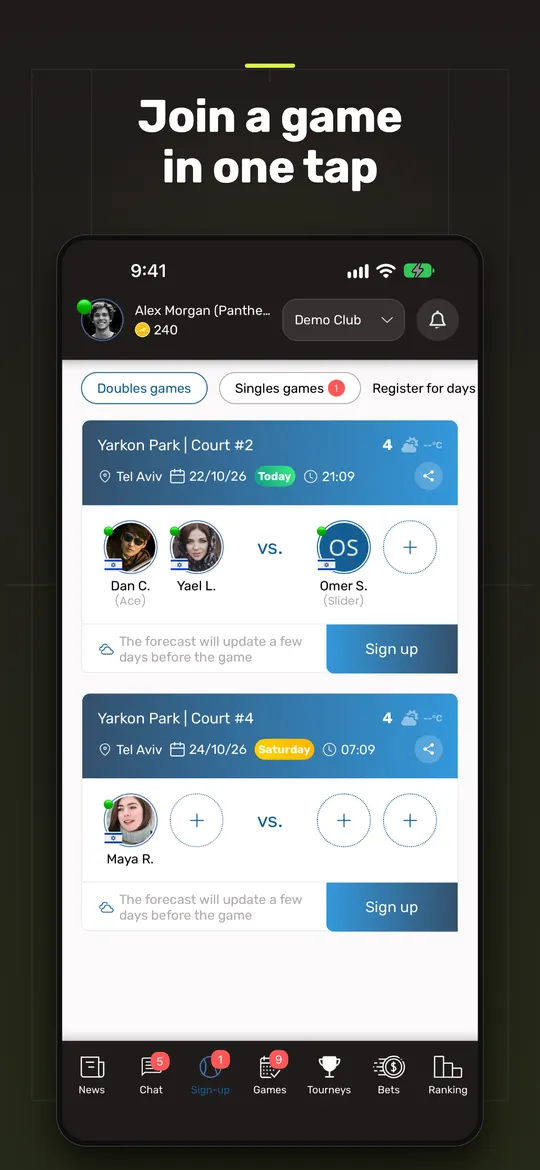
Scheduled games solve a different problem: four players, or two for singles, with a set time and court agreed in advance. You know you'll play, you know the level and you know who with. The cost is that someone has to organize it, and you meet fewer new people. Most clubs that grow end up running both. The real question is the mix.
1Decide which sessions are open and which are scheduled
Look at when your courts overflow. If weekday evenings have people waiting three games deep, that's where scheduled games by level take the pressure off. Quieter mornings and weekend afternoons usually suit open play.
Then write the week down: day, time, courts, open or scheduled, and level. Post it in one place and keep it the same from week to week, so players can build a routine around it. A schedule that changes every week teaches people to ask instead of look.
2Run open play with a rotation everyone can see
Open play feels fair only when everyone can see how the next game is chosen. A paddle rack or paddle stack by the courts does that: paddles go in a line, and the next four take the next free court. Pick one rotation rule and post it at the courts. Two common ones:
- Four off. All four players leave the court after each game and go to the back of the line. Simple, and the fairest when the line is long.
- Two off. The winners stay for one more game, split up, and each partners one of the next two players in line. More competitive, and it works better when the line is short.
Games to 11 keep the line moving. When people are waiting, one game and off is the rule worth enforcing.
As the club grows, split open play by level. Mark one or two courts for higher-level play at busy times, or run separate sessions, say 3.0 to 3.5 on one evening and 4.0 and up on another. Newer players get games they can enjoy, and the stronger players stop drifting away.
For busy sessions, ask people to RSVP so you know roughly how many are coming. Four players fill a court, and every extra four in line adds another game's wait for everyone.
3Use the skill scale, then check it
Most players know the half-point skill scale, from around 2.5 for newer players up to 5.0 and above. It's a useful shared language for labeling sessions and games. It's also self-reported, and self-ratings drift: some players rate themselves on their best day, others on their worst.
Check new players before you trust the number. Watching a few of their games, or a short evaluation session run by an experienced player, is usually enough. After that, let results guide you. A player who keeps winning comfortably in 3.5 games should be invited up, and a player who keeps losing will have more fun half a point lower.
Label every scheduled game with its level. If someone wants to play up, make it an invitation from the group rather than a free-for-all, so the game still works for the other three.
4Match the game length to the session
Games to 11, won by 2, are the standard and the right choice for open play: they're short, and the rotation keeps moving. Scheduled games have the court for the four of them, so they can go longer: a game to 15 or 21, or best of three games to 11, which suits a league or ladder match.
| Best of three, to 11 | Game 1 | Game 2 | Game 3 |
|---|---|---|---|
| Team 1 | 11 | 9 | 11 |
| Team 2 | 8 | 11 | 6 |
Agree the format before the first serve, and print it on the schedule for leagues and ladders. Arguments about whether a game was to 11 or 15 are entirely avoidable.
5Plan for indoor and outdoor courts
Outdoor courts depend on weather, wind and daylight. Indoor courts are usually rented by the hour or shared with other sports, so their times are fixed and limited. In places with real winters, much of the schedule moves indoors for months at a time.
Label every slot indoor or outdoor. Indoor and outdoor balls are different and players dress differently, so they need to know before they leave home. For outdoor games, decide in advance who calls a game off for rain or wind, and by what time, so nobody drives to a wet court.
6Fill scheduled courts before the day
A scheduled game with three players is a court nobody uses well. Check the half-full games the day before and on the morning of the game. Ask specific people at the right level who aren't already playing that day, rather than posting to the whole group, where everyone assumes someone else will answer. Ask the players who are already in, since they often know someone. And keep a short list of people who are happy to fill in at short notice.
Set a cancellation rule and stick to it. For example: after a fixed hour the day before, a player who drops out finds their own replacement.
7Record scores the same day
Ask players to enter the score straight after the game, in one agreed place, and give one person, the club manager, the right to correct mistakes. If you run a ladder or ranking, same-day scores are what keep it honest. The guide to club ladders and rankings covers the rest.
If players pay court fees or dues, keep a running balance per player instead of chasing every session. The weekly schedule guide explains how that works, and most of it applies to pickleball as it is.